
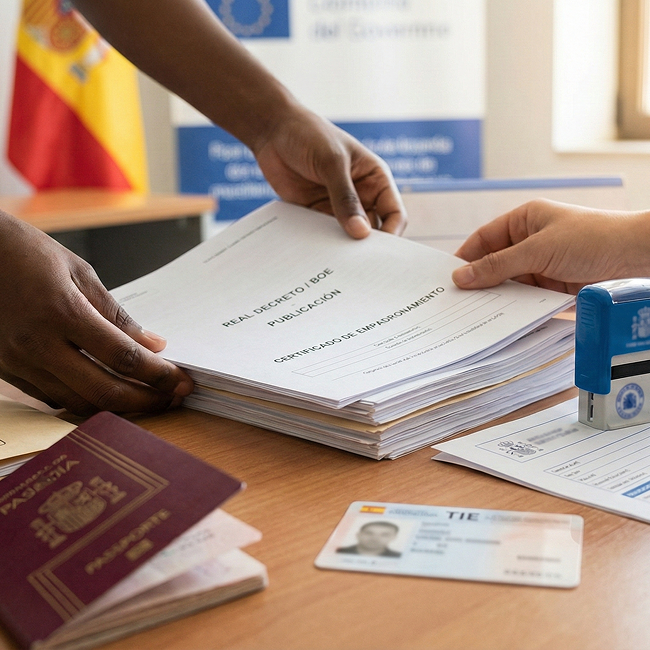
Spain’s Extraordinary Immigration Regularisation: Key Requirements and Entry into Force
Spain is preparing to implement an extraordinary regularisation process aimed at granting legal status to foreign nationals currently residing in the country without valid documentation. This measure represents one of the most significant developments in Spanish immigration law in recent years and may affect a substantial number of individuals living and working in Spain in an irregular administrative situation.
This article outlines the core requirements, procedural framework, and expected entry into force of the new regulation.
What Is the Extraordinary Regularisation?
The Government has approved a Royal Decree establishing a temporary and exceptional procedure allowing certain undocumented foreign nationals to obtain residence and work authorisation.
Unlike the ordinary residence pathways provided under the Immigration Law (Ley Orgánica 4/2000) and its Regulations, this is a one-off process with specific eligibility criteria and a limited application window.
Its purpose is twofold: to regularise individuals already integrated into Spanish society and the labour market, and to address structural labour shortages while strengthening legal certainty.
Entry into Force
The Royal Decree will enter into force once it is officially published in the Spanish Official Gazette (Boletín Oficial del Estado – BOE).
The application period is expected to open shortly after publication and remain available for a limited period. Applicants must submit their requests within the established timeframe, as late applications will not be accepted once the window closes.
Given the strict deadlines anticipated, early preparation of documentation will be essential.
Key Requirements
While the final wording of the regulation will determine the precise conditions, the main eligibility requirements are expected to include the following:
- Proof of Presence in Spain Before the Cut-Off Date
Applicants must demonstrate that they were physically present in Spain before the cut-off date established in the Royal Decree. This may be evidenced through empadronamiento certificates, medical records, rental agreements, utility bills, school enrolment records, transport tickets, or other documentary proof.
- Minimum Period of Continuous Stay
A minimum period of continuous residence in Spain will be required. The regulation is expected to establish a defined timeframe that must be demonstrably met at the time of application.
- Clean Criminal Record
Applicants must not have a criminal record in Spain or in their country of origin for offences recognised under Spanish law. Criminal record certificates may need to be legalised or apostilled and, where applicable, officially translated.
- No Ongoing Expulsion Order (in certain cases)
Depending on the final text, individuals subject to final expulsion orders may face limitations unless specific exceptions apply.
- Special Consideration for Asylum Seekers
Applicants for international protection who meet the relevant criteria and fall within the established dates may also benefit from the regularisation process under specific conditions.
What Does the Regularisation Grant?
Successful applicants will obtain:
- A temporary residence permit.
- Authorisation to work throughout Spain.
- Access to Social Security registration.
- Access to public healthcare and labour rights under Spanish law.
- The possibility, in certain cases, of including minor children.
This authorisation does not grant Spanish nationality, long-term residence automatically, or political rights. It constitutes a first step toward legal stability, which may later allow access to ordinary renewal pathways.
Legal and Practical Implications
Extraordinary regularisations are rare in Spain. The most notable precedent occurred in 2005. Such measures tend to generate political debate but also respond to social and economic realities: a significant number of individuals living and working in Spain without legal status.
From a legal standpoint, the process requires careful preparation. Documentary gaps, inconsistencies in empadronamiento records, or issues with criminal record certificates may lead to refusals if not properly addressed.
Professional legal advice is strongly recommended before submitting any application.
Frequently Asked Questions (FAQ)
- Who can apply for this regularisation?
Foreign nationals who were residing in Spain before the established cut-off date and who meet the remaining legal requirements set out in the Royal Decree. - What documents can prove residence in Spain?
Empadronamiento certificates are the most common form of proof, but other documents such as rental contracts, medical records, school certificates, utility bills, or dated official correspondence may also be valid. - Does this regularisation cancel previous fines or immigration sanctions?
Not automatically. Each case must be assessed individually, particularly where there are pending administrative proceedings or expulsion orders. - Can I apply if I have a criminal record in my country of origin?
Generally, a clean criminal record is required. However, the nature of the offence, its classification under Spanish law, and whether the record has been cancelled may be relevant. - Will this permit allow me to work immediately?
Yes. The residence authorisation granted under this process is expected to include work authorisation, allowing employment or self-employment in Spain. - Does this process lead directly to Spanish nationality?
No. Nationality requires meeting separate legal criteria, including a minimum legal residence period. - What happens after the temporary permit expires?
The permit may be renewable under the ordinary immigration regime, provided the holder meets the standard requirements at that time. - Is the application period open indefinitely?
No. This is an extraordinary and temporary measure. Applications must be submitted within the official timeframe established by the regulation.